Free Shipping above 5000 all over India
Farmers & Sourcing
Every heritage claim on this site starts here. This is the page that proves it.

Govt of Sikkim Enterprise
India's ODOP Initiative

GI-Tagged

22000:2018 Certified
Compliant
Some of what we protect now, a kingdom started protecting before certification existed.
Farmers & Sourcing
Every heritage claim on this site starts here. This is the page that proves it.
Govt of Sikkim Enterprise
India's ODOP Initiative
GI-Tagged
22000:2018 Certified
Compliant
Some of what we protect now, a kingdom started protecting before certification existed.
The Practice
The State Didn't Just Buy the Harvest. It Helped Sikkim Grow One Worth Buying.
How fair sourcing has worked here since long before it was a certification requirement.
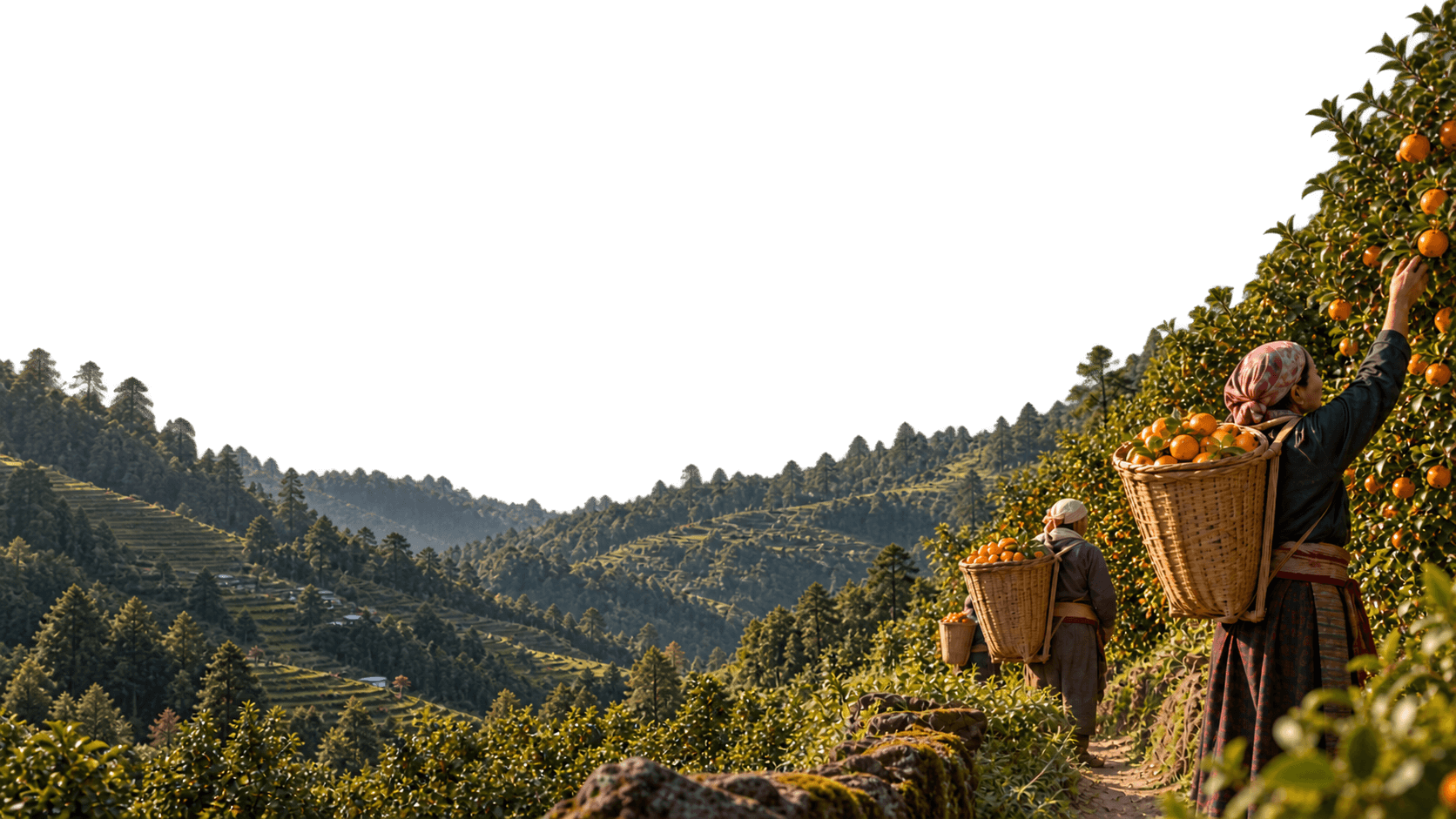
In its early decades, this institution’s role was often to be the market — a dependable, pre-agreed buyer for produce that otherwise had nowhere reliable to go. That’s not a marketing line; it’s documented. In 2007, GFPF finalised fair, agreed rates for a pear harvest from a grower in Kaphrey, giving that farmer — and others cultivating the same orchards — a reason to keep growing rather than let trees go unharvested. (Historical — presented as precedent, not a current case study.)
The same principle guided the state’s organic transition. When Sikkim began phasing out chemical fertilizers and pesticides in 2003, the orchards and farms supplying Sikkim Supreme converted alongside the rest of the state — not as a separate sourcing initiative, but as the same growers making the same shift everyone around them was making.
And when compliance came calling in the form of certification, we treated it as a door to open rather than a badge to display. Our own public statement on ISO 22000:2018 framed the benefit in exactly those terms: strengthening market access for produce supplied by Sikkim’s local tribal and small farmers.
Then there’s Dalle Khursani. The GI tag granted in 2020 makes it illegal for growers outside this specific belt to sell chillies under the same name — a legal protection, not a marketing one, that keeps the premium the market pays with the farmers who actually grow it here.
The Process
From Harvest to Jar
What actually happens between an orchard in Singtam and a bottle on your shelf.
1. Harvest.
Fruit and produce are picked at the point our quality standards call for — not simply whenever a buyer shows up.
2. Fair Purchase.
Growers are paid at pre-agreed, state-backed rates — settled ahead of harvest, not negotiated after the fact.
3. Preservation & Processing.
Produce moves to our Singtam facility quickly, where it’s processed under ISO 22000:2018 food safety standards before it has the chance to spoil.
4. Quality Testing.
Every batch is tested before it’s approved to leave the facility.
5. Distribution.
From Singtam to your door — retail, tourist, or hospitality order, same process, same standard.
This is the method that hasn’t changed since 1956: preserve it, purchase it fairly, process it, protect it. Only the scale has grown.
Where It Grows
The Land This Brand Was Built to Protect
Every ingredient in a Sikkim Supreme jar traces back to land that’s been farmed, and increasingly protected, with real intention.
Sikkim became the world’s first fully organic state in 2016, the endpoint of a transition that began in 2003. Our sourcing sits inside that same shift — the orchards and farms we work with are the same ones that converted, crop by crop, alongside the rest of the state.
A few of the ingredients that land defines:
- Oranges — the founding crop, still grown in and around Singtam, East Sikkim.
- Dalle Khursani — grown within the GI-protected belt covering Sikkim and parts of Darjeeling and north Bengal.
- Large Cardamom — grown in the shaded, high-altitude conditions this region is naturally suited to.
In a state that’s fully organic by policy, what grows here genuinely can’t grow the same way anywhere else.
Our Standards
What "Fair Sourcing"
Actually Means Here
Four commitments that apply to every harvest we buy, not just the ones we can name.